What is your money doing while you sleep?
Maybe it's sitting in an account, quietly losing value. I'll show you how I put my own money to work for me: no charts, no stock market know-how, and all my cards on the table.
- Account in your name
- Start from $250
- Capital withdrawable after 30 days
I’ve got something with a bit more ambition.

- > €200,000of our own money in copy trading
We learned how to work for money. Nobody taught us what happens next.
We learn pretty early on that we have to work to earn money. By our first paycheck at the latest, the idea is firmly in place: money is something you work for.
What nobody explained to me for a very long time: what does that money actually do once it's there?
Work. Earn money. Put some aside. Maybe invest. And if you're sensible, you're pleased that at some point there's a bit more than before.
At some point, a different question started to nag at me:
What is this money doing for me today?
I didn't want to know what some amount might turn into in 20 years. I wanted to know what my money was doing today. Really today. While I'm asleep. While we're out for dinner. While I'm walking the dogs. While I'm not thinking about it at all.
I don't have to turn trading into my next career. I don't have to read charts every day. I do have to understand what happens to my money, where it is, and how much risk I'm taking.
That's exactly why I use copy trading. And I'll show you how it works, what it costs and what you could lose.
Three steps. Market know-how optional.
I had zero interest in spending six months learning to trade, staring at charts and developing a new passion for candlestick patterns. With copy trading, a team of traders makes the trading decisions, and the trades are copied automatically into your own account.
- 01
You open your own account.
In your name, with the regulated broker TagMarkets. Your money stays with you, not with me and not with the trader.
- 02
You connect it to the strategy.
An experienced team of traders does the trading, supported by AI. You don't have to make a single market decision.
- 03
The trades run automatically.
You can see every trade in the app. You can withdraw your profits or leave them to keep working. Your call.
- Videos for every click
- Me, personally, on WhatsApp
- Emma, around the clock
My money doesn't need to take a break just because I do.
I don't want to organise my life around a job. I want time. For my husband Sascha. For our teenager. For Charly, Hope and Luke, our four-legged gang. For travel, friends, spontaneous days, and just as much for afternoons when absolutely nothing happens.
And at some point, this idea became much bigger for me than trading.
What happens if I can't work tomorrow? Or if one day I simply decide I don't want to anymore? Where does my money come from then? And how free am I really if my income always depends on me showing up and functioning?
That's when the way I looked at money changed. I wanted to build something, piece by piece, that keeps running even when I'm not doing anything for it.
Am I even allowed to think that? Not wanting to work anymore, even though I still could?


I don't recommend anything I don't do myself.
We started with €25,000. Over time, we kept adding capital and increased our stake step by step. Today we have more than €200,000 invested.
And just so you know what I'm talking about here: that's our own money.
Whether yours will one day be €1,000, €5,000 or €25,000 is entirely up to you. What matters is that you know where your money is, what happens to it, how much risk you're taking and whether this way of investing suits you at all.
At some point, we asked ourselves another question: what happens if we simply leave the profits in? We opened separate accounts for our children to find out. They all developed identically, so here's one of them:
- 97closed trades
- 90of them profitable
- 92.8%of trades in profit
The longest winning streak was 17 trades. Never more than one losing trade in a row. Biggest single win: €181.17. Biggest single loss: €55.39.
The profits stayed in the account and kept working in the trades that followed. Of course, next month could look completely different. This is the past.
Numbers I didn't make up.
The strategy is called Sonic. It trades a real account with TagMarkets, and its complete history has been public on MyFXBook since November 2024. As of 25 Sept 2026.
What the trader does. And what reaches you.
The bars show the trader's performance without leverage, exactly as MyFXBook displays it. On your account, the 24x leverage comes on top, minus a 30% profit share. That's why the red figure under each month shows roughly what would have reached you, net.
- 0.61%Jan≈ 10%
- 0.55%Feb≈ 9%
- 0.80%Mar≈ 13%
- 1.27%Apr≈ 21%
- 1.09%May≈ 18%
- 1.06%Jun≈ 18%
- 1.16%Jul≈ 19%
- 0.88%Aug≈ 15%
- 1.04%Sep≈ 17%
Source: MyFXBook, Monthly Gain 2026, as of 25 Sept 2026. September wasn't complete yet at that point. Net figures are rounded examples, not a promise of returns.
And now in euros.
Percentages on their own don't mean much to me. It only gets interesting when I see what they mean in real amounts.
Purely arithmetical, at 13–19% net. Not a promise of returns: future results may be lower or negative.
That's when I started asking myself why money should just sit around anywhere when I could give it a job.
Because 12 or 15 percent a month doesn't just fall from the sky.
This is where leverage comes in. The word sounds more complicated than it is. We work with 24x leverage. Put simply: €1,000 of your own capital becomes a trading volume of €24,000.
So the trader doesn't need to make 20 or 30 percent. Even small results from the strategy are amplified by the leverage:
1% trader performance × 24 = 24%
At 1.5%, it would be 36%. So it's not about making huge profits on individual trades. Lots of small results add up to the month's result.
Of course, leverage works the other way too: losses are amplified as well. That's why there's a fixed limit: if the strategy hits a 5% loss, it is stopped. The capital you've invested can be lost in the process. Leverage makes these results possible. But it's also one of the reasons trading always comes with risk.
Curiosity costs nothing. Naivety does.
I don't believe numbers just because they look good. These days I'm pretty suspicious of numbers. I'm not only interested in what they say. I want to know how they come about.
Where is my money? Who can access it? What happens if the strategy makes a loss? When can I get my capital back? And who earns what? Those are the things I want to know before I put money in anywhere. Here are my answers.

Where is my money?
In your own account with TagMarkets, in your name. I have no access and can't deposit or withdraw anything.
Is the broker regulated?
Your account is held with T.M. Financials Ltd., regulated by the Financial Services Commission of Mauritius (FSC). According to the provider, client funds are also protected in case the broker becomes insolvent.
Can I reinvest my profits?
Yes. If you leave your profits in the account, they keep working in the next trades. That's exactly how €2,500 became €5,007 in our children's accounts.
How do I get my money out?
You can generally withdraw profits at any time: crypto from $10, bank transfer from $500. Your capital is tied up for the first 30 days. Important: every reinvestment restarts the 30 days.
How often does it trade?
Gold/USD usually one or two trades a day, EUR/USD one at most. Some weeks are quieter.
What could I lose?
In the worst case, the capital you've invested, including any reinvested profits. Only invest money you don't need for everyday life.
Spoiler: most of it stays with you.
In other words: nothing is shared until your account has actually made a profit. Nobody gets paid for your sign-up or your deposit.
Yes. You can also lose money.
I would never tell you trading is risk-free. It isn't. Losing trades are part of it. Leverage amplifies both directions. Past results don't guarantee future ones, and the capital you invest can be lost completely.
That's why I don't just look at what's possible. I want to know just as much what happens in the worst case, where the limit is, and whether I can follow what's happening with my money at any time.
I'm not the only one who sleeps well.

"For me personally, this has honestly been life-changing in a way."
They're not huge sums yet. But when I see what my original 600 dollars has turned into in less than ten months, even though I've already taken money out along the way, that's huge for me.

"I can treat myself now and then without touching my regular income."
I've deposited a total of 2,690.10 US dollars and withdrawn 4,094.90 US dollars so far. That means I've already taken out 1,404.80 US dollars more than I put in.

"Two of my three strategies doubled within a few months."
I know profits aren't guaranteed. My plan is to withdraw my original stake first and then keep going with the profits.
Individual personal experiences, not typical or expected results. Quotes translated from German.
A quick reality check.
Copy trading isn't for everyone. And that's a good thing. Read both sides, and you'll know pretty quickly where you stand.
It's a good fit if …
- you have money you don't need for everyday life that can calmly work for you.
- you have no desire to learn trading or read charts every day.
- you know losses are part of it, and you stay calm anyway.
- you think long term and have some patience.
It's not a good fit if …
- you would use your emergency savings or take out a loan for it.
- you want a guarantee. There isn't one here.
- you'll definitely need this money in the next few weeks.
- you'd nervously check your balance every day.
- you expect every month to go equally well.
- you want to get rich overnight.
I won't leave you alone with this, by the way.
Maybe you're thinking right now: open an account, get verified, deposit … can I even do this? Yes, you can. I've prepared every step so you don't have to struggle through it alone, and setting up usually only takes a few minutes. And if questions come up afterwards, you'll get answers: from Emma around the clock, and from me personally.
- 01An account in your nameWith the regulated broker TagMarkets. Only you can access your money.
- 02Step-by-step videosOpen your account, get verified, deposit, connect. As often as you like.
- 03Me, personally, on WhatsAppWhen something gets stuck or you're unsure. No hotline in between.
- 04A Telegram channel for clientsUpdates on strategies and payouts, straight to your phone. Access once you've started.
- 05Emma, around the clockAnswers on risk, withdrawals, deadlines and fees, instantly.
- 06Full transparencyEvery trade in your app, the complete history on MyFXBook and my trader analysis.
- 07No upfront feesNo subscription, no joining fee. Profits are only shared when you make a profit.
- 08Start from $250How much you invest is up to you. You can top up any time.
The questions that usually show up at 3 a.m.
Do I need any prior knowledge?
No. You don't need to know how to trade or read charts. All that matters is that you understand where your money is and how much risk you're taking. That's exactly what this page is about.
How much do I need to invest?
You can start from $250. How much you invest is up to you. Some start with the minimum, others go straight in with more. You can top up any time.
What does it cost me?
There's no joining fee and no subscription. Apart from the usual broker commission, something is only shared when you make a profit: you keep 70%. If there's a loss, there's no profit share.
Can I stop again?
Yes. You can disconnect from the strategy, withdraw your profits and, after the 30-day period, your capital too. Withdrawals go back the same way you deposited, so bank to bank or crypto to crypto.
How do I deposit?
By crypto, bank transfer or card. The onboarding videos show you every click.
Doesn't this sound too good to be true?
Good question, I asked myself the same thing. The numbers come from leverage, not magic, and they're publicly verifiable on MyFXBook. But leverage also means real risk. That's why I show you both openly, and you decide for yourself what's right for you.
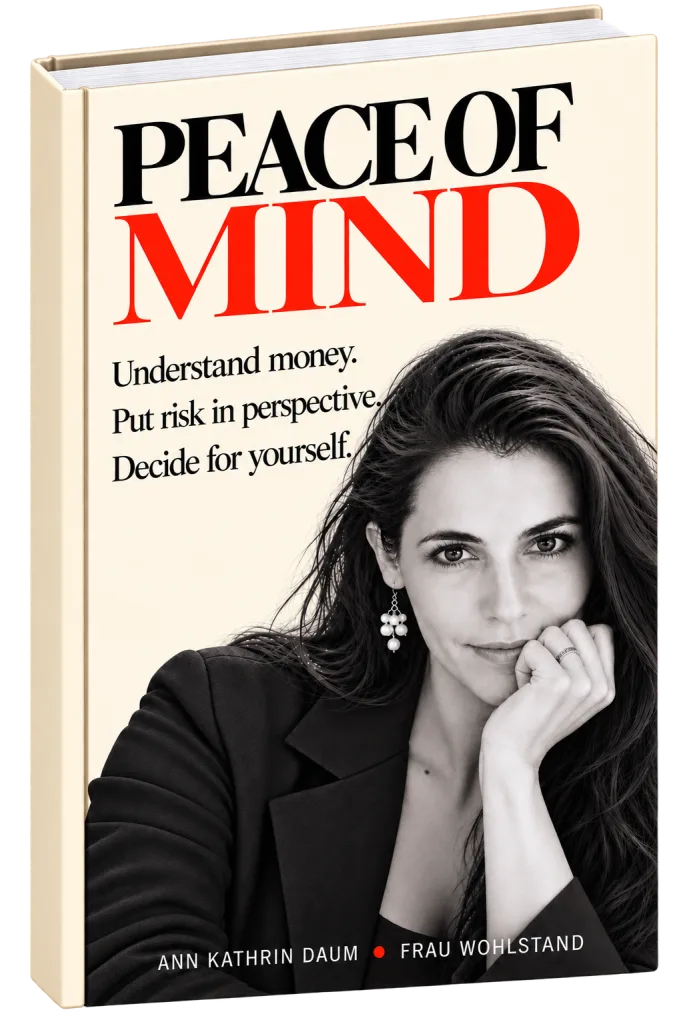
Peace of Mind.
Maybe you've become curious at this point and, at the same time, you're thinking: before I put money anywhere, I want to understand what we're actually talking about. That's exactly why I wrote "Peace of Mind".
I could have used this book myself much earlier. Because for a long time, there were only two states when it came to money: either I had no idea, or someone was explaining something to me in a language that lost me after three sentences.
In the book, I start much earlier. With the question of what happens to your money when you do nothing with it at all. Why doing nothing is a decision too. Where this damn fear of investing comes from. And eventually, of course, how forex, leverage, brokers and copy trading fit together.
It's not about learning ten new technical terms. I want you to be able to put numbers into perspective. And to spot it when someone is feeding you nonsense.
"This book is exactly that: the conversation I wish I'd had back then."
To the book · €29.90
So. What is your money doing now?
You know the numbers now. You know how the account works, where your money is, how profits are shared and what risk comes with it. And you know how much of our own capital we have in it.
Maybe you already have an amount in mind. €1,000. €5,000. €10,000. Maybe a lot more.
Many people put off the topic of money for years because they think they first need to save up a large amount. You don't. You can start from as little as 250 dollars.
If you now want to know what getting started with your own money actually looks like, you don't need another example calculation. Just take a look at how it works.
I want to get started